There's a story in the Gospels that tells of a time when Jesus went into a temple and threw out all the merchants doing business there. We've all heard it. The lesson we learn from this incident is that the house of God is not a place to sell things. It's not that hard; just keep your money to yourself when you're at church (except when your pastor tells you about the fellowship hall renovation project and the gold plates start getting passed around).
I'm not sure this passage justifies our silent judgments about the lady who not-so-subtly promotes her Scentsy products during Sunday School, and I definitely don't think it should stop us from buying Girl Scout cookies from her daughter after the service. I think what Jesus does at the temple in Matthew 21 demonstrates his frustrations with a church that has become corporate* and impersonal, so obsessed with marketing to the right audiences, luring people in with new campaigns, and trying to sell a mass-produced, bottled-up "God" that it forgets about the people who are there to pray.
When we ask, "What do millennials [or insert any group of people here] need from the church?" we're asking a marketing question. When we ask, "How can we reach these people or those people?" we're asking a marketing question. These questions belong to businesses, not to churches. When we ask those questions, we're really saying, "How can we alter God--create a certain image of God--to appeal to X, Y, or Z?"
That story in the Bible isn't telling us that Jesus doesn't want us to sell things in the church; it's telling us that Jesus doesn't want us to sell God in the church.
And so, in case you're worried you might be attending a business every Sunday morning instead of a church, I've put together two lists: 1) Characteristics of a corporation 2) Characteristics of a community (the original church Jesus modeled to us with his disciples)
Corporations sell things. Communities share things.
Corporations promote hierarchy. Communities promote equality.
Corporations downsize their people to grow business. Communities grow their people to downsize ignorance.
Corporations are machines. Communities are beings.
Corporations outsource. Communities insource.
Corporations see economic value. Communities see inherent value.
Corporations are about networking. Communities are about developing relationships.
Is your church a corporation or community? Is it a house of prayer or a den of robbers?
...
[Acts 2:44 All the believers were together and had everything in common.]
*On a related note, can we please, please, please get rid of the term "corporate worship"?

Friday, December 18, 2015

Monday, October 5, 2015
King Hezekiah's Prayer
One of the lessons at choral evensong this month was from 2 Kings 20. It tells of King Hezekiah, who, after having been told by the prophet Isaiah that his life would soon end, prayed to God and wept, saying, "Remember now, O Lord, I implore you, how I have walked before you in faithfulness with a whole heart, and have done what is good in your sight" (2 Kings 20:3, NRSV). Because of this, God tells Isaiah to return to Hezekiah and tell him, "Thus says the Lord, the God of your ancestor David: I have heard your prayer, I have seen your tears; indeed, I will heal you; on the third day you shall go up to the house of the Lord. I will add fifteen years to your life" (verses 5-6).
This is one of my favorite parts of the Bible. My heart is full when I read those words: "I have heard your prayer, I have seen you tears; indeed, I will heal you." Even so, prayer tends to be the last thing on my mind in difficult and discouraging circumstances. Prayer is something I often avoid--first, because I always seem to be at a loss for words when it comes to approaching and engaging with the Divine so intentionally, and second, because I have grown accustomed to dismissing prayer as an illegitimate solution. You cannot simply whisper some words while you're on your knees and let them float away like a message in a bottle, expecting something will happen because of them. Intellectualism has conditioned me to hold that prayer is not a sensible practice.
And yet, the truth that emerges from the story of King Hezekiah is that something about prayer makes sense in times of illness and suffering.
Prayer, for so much of my life, has been one of those things that's a bit too mystical for me. I have distrusted it because I have not seen a rational explanation for it. I could tell people I was praying for them or bow my head during prayer at church, but in my mind, I regarded prayer as just another ritual the church has held onto--something that doesn't have any real power.
And then I had my own Hezekiah moment. A few years ago, during a period of intense anxiety and sadness, a counselor recommended prayer. At first, this prescription made me angry. I thought, "Really? You went to school for how many years, and that's all you have to offer?" But because I had no other options, I started saying the Lord's Prayer every night as I lay in bed, trying to fall asleep. I would repeat it over and over until I woke up the next morning, unsure when my prayer had ended and my sleep had begun.
Science Mike talks about prayer in his Axioms About Faith, saying, "Prayer is AT LEAST a form of meditation that encourages the development of healthy brain tissue, lowers stress, and can connect us to God. EVEN IF that is a comprehensive definition of prayer, the health and psychological benefits of prayer justify the discipline." Even if all the Lord's Prayer was for me during those otherwise restless nights was a mantra to put me to sleep, the days following, in which I felt more awake and present to the world around me and less burdened by the anxieties of those nights, were enough their own miracle that I felt my prayers had been answered.
It seems to me that the Mystery of Life likes to work this way, teaching us that prayer is perhaps not the request for a miracle but the ordinary, unexpected miracle itself. Prayer is the sudden peace of deep sleep. Prayer is the fig-poultice that heals us. It is spit and dirt, mud that restores our sight.
Prayer provides serenity, and at the same time, it wakes us up. When we gather for our evening prayer at my house, we say our petitions and thanksgivings, and they are entirely connected to the way we go about our daily lives. My prayer for peace for a coworker grieving the loss of her mother follows me to work the next day, a reminder to be present to her experience and needs. My prayer for those affected by drought stays with me, a reminder to be grateful and to be wise about the resources I use. Prayer is rest, and prayer is action. What a miracle that it can be both.
After we heard the lessons at choral evensong, we took a moment for intercessions and thanksgivings. Because I could think of nothing else, I said the Lord's Prayer--a thanksgiving for all the times I had prayed as a last resort and for all the times that simple thing of drawing, humbly and desperately, towards the Divine had, in itself, been the answer and miracle.
This is one of my favorite parts of the Bible. My heart is full when I read those words: "I have heard your prayer, I have seen you tears; indeed, I will heal you." Even so, prayer tends to be the last thing on my mind in difficult and discouraging circumstances. Prayer is something I often avoid--first, because I always seem to be at a loss for words when it comes to approaching and engaging with the Divine so intentionally, and second, because I have grown accustomed to dismissing prayer as an illegitimate solution. You cannot simply whisper some words while you're on your knees and let them float away like a message in a bottle, expecting something will happen because of them. Intellectualism has conditioned me to hold that prayer is not a sensible practice.
And yet, the truth that emerges from the story of King Hezekiah is that something about prayer makes sense in times of illness and suffering.
Prayer, for so much of my life, has been one of those things that's a bit too mystical for me. I have distrusted it because I have not seen a rational explanation for it. I could tell people I was praying for them or bow my head during prayer at church, but in my mind, I regarded prayer as just another ritual the church has held onto--something that doesn't have any real power.
And then I had my own Hezekiah moment. A few years ago, during a period of intense anxiety and sadness, a counselor recommended prayer. At first, this prescription made me angry. I thought, "Really? You went to school for how many years, and that's all you have to offer?" But because I had no other options, I started saying the Lord's Prayer every night as I lay in bed, trying to fall asleep. I would repeat it over and over until I woke up the next morning, unsure when my prayer had ended and my sleep had begun.
Science Mike talks about prayer in his Axioms About Faith, saying, "Prayer is AT LEAST a form of meditation that encourages the development of healthy brain tissue, lowers stress, and can connect us to God. EVEN IF that is a comprehensive definition of prayer, the health and psychological benefits of prayer justify the discipline." Even if all the Lord's Prayer was for me during those otherwise restless nights was a mantra to put me to sleep, the days following, in which I felt more awake and present to the world around me and less burdened by the anxieties of those nights, were enough their own miracle that I felt my prayers had been answered.
It seems to me that the Mystery of Life likes to work this way, teaching us that prayer is perhaps not the request for a miracle but the ordinary, unexpected miracle itself. Prayer is the sudden peace of deep sleep. Prayer is the fig-poultice that heals us. It is spit and dirt, mud that restores our sight.
Prayer provides serenity, and at the same time, it wakes us up. When we gather for our evening prayer at my house, we say our petitions and thanksgivings, and they are entirely connected to the way we go about our daily lives. My prayer for peace for a coworker grieving the loss of her mother follows me to work the next day, a reminder to be present to her experience and needs. My prayer for those affected by drought stays with me, a reminder to be grateful and to be wise about the resources I use. Prayer is rest, and prayer is action. What a miracle that it can be both.
After we heard the lessons at choral evensong, we took a moment for intercessions and thanksgivings. Because I could think of nothing else, I said the Lord's Prayer--a thanksgiving for all the times I had prayed as a last resort and for all the times that simple thing of drawing, humbly and desperately, towards the Divine had, in itself, been the answer and miracle.
Thursday, September 17, 2015
This is what Christ looks like today
Note: this post was written 9/5, published 9/17.
 My first thought when I see the photo of Aylan Kurdi, a Syrian child, face down and lifeless in the sand of a Turkish beach? My faith is pointless. My faith is naïve. My faith is irrelevant.
Every time it's like this. I have a momentary lapse in hope. Complete and utter defeat in the face of something so, so out of my reach. I think it's because I still cling to a fragment of my childhood understanding of faith and of Christ. My old understanding tells me that those who suffer need only eternal salvation. It leaves me hopeless. Because if I suffered as these Syrian refugees now do (and I don't, not even close), I would scoff at a Savior who offered heaven and that's it. It's absurd and disgusting how irrelevant that Christ is.
So I have to remind myself each time. Jesus' death on the cross is not relevant today because it promises salvation and eternal life. It is relevant because it points to injustice. Jesus knew what it was like to suffer at the hands of injustice. Those were the hands that put him on the cross. Right now, we are those people in the crowd, screaming, "Let him be crucified!" And when asked, "Why, what evil has he done?", we scream louder: "Let him be crucified!" because we have no other reason; injustice never makes any sense (Matthew 27:22-25, NRSV).
With these words, we take his blood upon us. And if we are silent? His blood is still upon us.
Others have made these calls to action, but I will repeat them for good measure: choose to be aware rather than ignore, donate to a responsible relief fund (Save the Children, World Vision), sign a petition, or two, or ten (White House dot Gov petition to welcome refugees to U.S.), and get your church or community to do the same.
 My first thought when I see the photo of Aylan Kurdi, a Syrian child, face down and lifeless in the sand of a Turkish beach? My faith is pointless. My faith is naïve. My faith is irrelevant.
Every time it's like this. I have a momentary lapse in hope. Complete and utter defeat in the face of something so, so out of my reach. I think it's because I still cling to a fragment of my childhood understanding of faith and of Christ. My old understanding tells me that those who suffer need only eternal salvation. It leaves me hopeless. Because if I suffered as these Syrian refugees now do (and I don't, not even close), I would scoff at a Savior who offered heaven and that's it. It's absurd and disgusting how irrelevant that Christ is.
So I have to remind myself each time. Jesus' death on the cross is not relevant today because it promises salvation and eternal life. It is relevant because it points to injustice. Jesus knew what it was like to suffer at the hands of injustice. Those were the hands that put him on the cross. Right now, we are those people in the crowd, screaming, "Let him be crucified!" And when asked, "Why, what evil has he done?", we scream louder: "Let him be crucified!" because we have no other reason; injustice never makes any sense (Matthew 27:22-25, NRSV).
With these words, we take his blood upon us. And if we are silent? His blood is still upon us.
The Christian faith has to be about Christ. And Christ was absolutely and entirely about facing injustice with compassion. He did the most compassionate thing, dying on a cross. I love that cross. Not because it saves me from eternal suffering in hell but because it saves me from myself--the hell I create for myself and the rest of the world when I do not choose compassion like Christ did and when I do not choose action on behalf of those who suffer hell on earth. The cross is what reminds me, when injustice causes people to anguish, that God is with us. He is there in that suffering. He suffered with the least of these and in so doing called the least of these Christ. We do not get to love Jesus without doing for the refugee what we would do for Jesus. It is simply not allowed.
And so, my faith is nothing if it does nothing for these Syrian refugees. Christ's death means nothing if his followers do nothing for children like Aylan. We, as Christians, are nothing in this world if we refuse to see that each person who suffers is Christ. Jesus is still relevant because he died and was found washed up on the shore of Turkey just three days ago.
Thursday, August 27, 2015
Are you there, God?: Calling God Without a Phone
I was raised in the Pentecostal tradition. I know people that can do the arms raised, dancing in the pew thing. I've seen someone speak in tongues at church, and a couple of my friends have used the phrase "slain in the Spirit" on more than one occasion. While the church I grew up in wasn't all that charismatic, I thought that was how you experienced God. Even now, among my evangelical peers, fervent worship and prayer are the exclusive methods used to connect with God.
I wouldn't have been able to articulate this at the time, but beginning at about fifteen, church started to not make sense. I didn't feel God's presence when I entered the sanctuary, when we sang worship songs, or when I prayed. While my church gave me a way in which to talk to God (a phone, if you will), I kept getting disconnected. There was an absence of God in my life not because I had deliberately chosen that for myself but because, despite attempts, I could not feel God, particularly at church, where I thought it should have been the easiest.
Today, when a worship leader asks the congregation to lift its hands, my discomfort level goes through the roof. I get self-conscious, and I can't imagine being more disconnected from God. I don't like praying because I can never articulate my thoughts, so most of the time I end up just repeating a word that in some way captures what I want to say (and if that sounds a lot like meditation, that's probably because it is). Other times, I find the most peace in saying the Lord's Prayer over and over again.
And yet what I hear is that more traditional worship is for the apathetic. Tradition and liturgy are safe and lazy, and that is not where you encounter God. What I hear is that practices like meditation have roots in eastern religions, so it is wrong to meditate even though Paul instructs the Philippians to meditate on "whatever is true, whatever is honorable, whatever is just, etc" (Philippians 4:8, NRSV).
I don't want the ten-piece band, the elaborate strobe light shows, and the Hillsong music blasting in my ears. I don't need to feel like I'm at a rock concert. The kingdom of God is not on the stage but within me (Luke 17:21), so why does it matter that I'm in the woods instead of the pew on Sunday morning?
Everyone's spirituality is different. Doesn't that make sense, though? After all, everyone's spirit is different. The National Interfaith Conference on Aging defines spiritual well-being as "the affirmation of life in relationship with God, self, community, and environment that nurtures and celebrates wholeness." Which means you can feel God's spirit singing "Give Me Jesus" or a Latin hymn, in song at church or in silence at the top of a mountain. Awe and wonder can happen whether you are physically prostrate or not.
Growing up, the one service at my parents' church I looked forward to every year was the Christmas Eve service. It was the same every year. We heard the story of Jesus' birth. We sang the traditional Christmas hymns. We ended the night with candles and Silent Night. That was when I felt most connected to God, and honestly, when I felt the most connected to the rest of the church. Stripped down to a simple ritual, God becomes known. At least, that's how it is for me.
The phone doesn't work for me. Instead, I'll speak to God using a hairbrush. And maybe for someone else it'll be a shoe. When we stop forcing the phone into others' hands and asserting one spiritual hegemony (even when it's not on purpose), they can live more fully spiritual lives without feeling they have to completely leave the church or their faith.
I wouldn't have been able to articulate this at the time, but beginning at about fifteen, church started to not make sense. I didn't feel God's presence when I entered the sanctuary, when we sang worship songs, or when I prayed. While my church gave me a way in which to talk to God (a phone, if you will), I kept getting disconnected. There was an absence of God in my life not because I had deliberately chosen that for myself but because, despite attempts, I could not feel God, particularly at church, where I thought it should have been the easiest.
Today, when a worship leader asks the congregation to lift its hands, my discomfort level goes through the roof. I get self-conscious, and I can't imagine being more disconnected from God. I don't like praying because I can never articulate my thoughts, so most of the time I end up just repeating a word that in some way captures what I want to say (and if that sounds a lot like meditation, that's probably because it is). Other times, I find the most peace in saying the Lord's Prayer over and over again.
And yet what I hear is that more traditional worship is for the apathetic. Tradition and liturgy are safe and lazy, and that is not where you encounter God. What I hear is that practices like meditation have roots in eastern religions, so it is wrong to meditate even though Paul instructs the Philippians to meditate on "whatever is true, whatever is honorable, whatever is just, etc" (Philippians 4:8, NRSV).
I don't want the ten-piece band, the elaborate strobe light shows, and the Hillsong music blasting in my ears. I don't need to feel like I'm at a rock concert. The kingdom of God is not on the stage but within me (Luke 17:21), so why does it matter that I'm in the woods instead of the pew on Sunday morning?
Everyone's spirituality is different. Doesn't that make sense, though? After all, everyone's spirit is different. The National Interfaith Conference on Aging defines spiritual well-being as "the affirmation of life in relationship with God, self, community, and environment that nurtures and celebrates wholeness." Which means you can feel God's spirit singing "Give Me Jesus" or a Latin hymn, in song at church or in silence at the top of a mountain. Awe and wonder can happen whether you are physically prostrate or not.
Growing up, the one service at my parents' church I looked forward to every year was the Christmas Eve service. It was the same every year. We heard the story of Jesus' birth. We sang the traditional Christmas hymns. We ended the night with candles and Silent Night. That was when I felt most connected to God, and honestly, when I felt the most connected to the rest of the church. Stripped down to a simple ritual, God becomes known. At least, that's how it is for me.
The phone doesn't work for me. Instead, I'll speak to God using a hairbrush. And maybe for someone else it'll be a shoe. When we stop forcing the phone into others' hands and asserting one spiritual hegemony (even when it's not on purpose), they can live more fully spiritual lives without feeling they have to completely leave the church or their faith.
Saturday, August 22, 2015
Real Life Radical.. and When We're Just Pretending
As Christians, we like to think of ourselves as radical. Often, we hear the word thrown around at church camps and campus ministry retreats. Mostly it's at times in our lives when there's a lot of pressure to conform to whatever the dominant culture is. Thank God we have these strong disciplers to remind the youths that we don't need to be cool or fit in because, after all, we have Jesus.
In the spirit of rejecting dominant culture, the guy on stage at these shindigs typically sports a youth pastor beard, skinny jeans, and a Jesus is Dope sweatshirt, and boy, can he use the word countercultural in a sentence (or four)! And when he starts talking about how radical it is to do this and not do that, we get PUMPED. We're thinking, if this is what radicalism looks like, it is hella attractive.
The thing is, underneath the alluring rhetoric, what that guy's describing is not all that radical.
First, a vocabulary lesson: radical is the "fundamental nature" of something; it gets back to the reality at the root of things and does, in fact, also refer to what proceeds from the root of a plant. Radical can also relate to social and political reform. It is always complete, comprehensive, thorough.
So let's set the record straight.
We are not radical for hosting Bible study on Friday nights--even while our peers are at the bars. We aren't radical for sharing the gospel with ten of our non-Christian friends, relatives, coworkers, and the rando we just met at Kum n' Go who really needs Jesus. We aren't radical for abstaining from sex until marriage. We aren't radical for going to church every Sunday or for memorizing Bible verses. We aren't radical for listening to Christian radio instead of rap, for confessing to and praying with our accountability partners every time we use God's name in vain, lust, or cause our brothers in Christ to stumble.
All of the above are things we may choose that others in our culture do not, but that doesn't make us radical. These are things we do that the rest of the world understands (and frankly, doesn't care about) because they are the "Christian things to do."
Radical is when we do something that the rest of the world does not understand. Radical actions are those things that make the world ask, "Why?" They are actions that provide the opportunity to explain with hopes to transform. And when those transformations happen, they are complete, comprehensive, thorough. Radical actions that lead to transformations are not localized and confined to personal purity and morality. They are global.
Indeed, radical Christianity* is not when we participate in systems of individual purity but rather when we participate in systems of social change. Because radical has to do with the roots--or the basic realities--of the world, truly radical actions--rather than maintaining a distance through absorption with self and self-morality--confront those realities. They demand a complete overhaul of the world.
When we live in community, sharing our cars and washing machines with those around us even when we don't have to, that is radical. When we give up something simply out of solidarity for those who go without because they have to, that's radical. When we share our presence with the sick and dying who would otherwise be alone. When we mindfully consume because most consumption comes at the cost of fairness. When we challenge our communities to talk about (or better yet, listen) racial injustice and gender inequality instead of pretending it doesn't exist. When we acknowledge the privilege we possess, we open up space for and redirect attention towards those who don't, and that is radical. When we extend grace to everyone. When we take up our crosses and follow Jesus. But most importantly, when we open our eyes to the crosses that others bear, choosing to see Christ in the least of these--that is radical. That causes change at the roots.
*Christians do not hold a monopoly on radicalism.
In the spirit of rejecting dominant culture, the guy on stage at these shindigs typically sports a youth pastor beard, skinny jeans, and a Jesus is Dope sweatshirt, and boy, can he use the word countercultural in a sentence (or four)! And when he starts talking about how radical it is to do this and not do that, we get PUMPED. We're thinking, if this is what radicalism looks like, it is hella attractive.
The thing is, underneath the alluring rhetoric, what that guy's describing is not all that radical.
First, a vocabulary lesson: radical is the "fundamental nature" of something; it gets back to the reality at the root of things and does, in fact, also refer to what proceeds from the root of a plant. Radical can also relate to social and political reform. It is always complete, comprehensive, thorough.
So let's set the record straight.
We are not radical for hosting Bible study on Friday nights--even while our peers are at the bars. We aren't radical for sharing the gospel with ten of our non-Christian friends, relatives, coworkers, and the rando we just met at Kum n' Go who really needs Jesus. We aren't radical for abstaining from sex until marriage. We aren't radical for going to church every Sunday or for memorizing Bible verses. We aren't radical for listening to Christian radio instead of rap, for confessing to and praying with our accountability partners every time we use God's name in vain, lust, or cause our brothers in Christ to stumble.
All of the above are things we may choose that others in our culture do not, but that doesn't make us radical. These are things we do that the rest of the world understands (and frankly, doesn't care about) because they are the "Christian things to do."
Radical is when we do something that the rest of the world does not understand. Radical actions are those things that make the world ask, "Why?" They are actions that provide the opportunity to explain with hopes to transform. And when those transformations happen, they are complete, comprehensive, thorough. Radical actions that lead to transformations are not localized and confined to personal purity and morality. They are global.
Indeed, radical Christianity* is not when we participate in systems of individual purity but rather when we participate in systems of social change. Because radical has to do with the roots--or the basic realities--of the world, truly radical actions--rather than maintaining a distance through absorption with self and self-morality--confront those realities. They demand a complete overhaul of the world.
When we live in community, sharing our cars and washing machines with those around us even when we don't have to, that is radical. When we give up something simply out of solidarity for those who go without because they have to, that's radical. When we share our presence with the sick and dying who would otherwise be alone. When we mindfully consume because most consumption comes at the cost of fairness. When we challenge our communities to talk about (or better yet, listen) racial injustice and gender inequality instead of pretending it doesn't exist. When we acknowledge the privilege we possess, we open up space for and redirect attention towards those who don't, and that is radical. When we extend grace to everyone. When we take up our crosses and follow Jesus. But most importantly, when we open our eyes to the crosses that others bear, choosing to see Christ in the least of these--that is radical. That causes change at the roots.
*Christians do not hold a monopoly on radicalism.
Sunday, August 9, 2015
Covenant
Isn't it good to know the worst is over? Isn't it assuring to hear the promise that it's downhill from here on out? It's why the story of God's covenant with Noah is told over and over again, starting in the early years of Sunday school. God is good, we teach the kids. Look at how God made a covenant to Noah, promising to never flood the earth again. It was like God said, "The worst is over," and here's a rainbow to prove it.
"When I bring clouds over the earth and the bow is seen in the clouds, I will remember my covenant that is between me and you and every living creature of all flesh; and the waters shall never again become a flood to destroy all flesh" (Genesis 9:14, NRSV).
I want to know that the worst is over. And unlike Noah, God's probably not going to give me a sign and a promise that whatever I dealt with six months ago, whatever my best friend or brother went through last week, whatever--that was the worst of it. A rainbow still just means that the storm is over, that God will never flood the earth again, and I'm left unsure about whether or not I'll ever have to experience as much pain as I did that one time, during that one season.
And that sucks. Because when you endure your own version of Noah's flood, you want to believe that that was the worst, and you can't imagine there could be anything worse. We yearn for a promise from God the way Noah probably would have had God not provided the rainbow. Instead, we have turn to God's grace. We have to trust that no matter the darkness we experience, God will extend grace--to us and to anyone that contributed to that darkness. And while that may not feel good like a rainbow, it's still a constant and in its own way, a promise.
"When I bring clouds over the earth and the bow is seen in the clouds, I will remember my covenant that is between me and you and every living creature of all flesh; and the waters shall never again become a flood to destroy all flesh" (Genesis 9:14, NRSV).
I want to know that the worst is over. And unlike Noah, God's probably not going to give me a sign and a promise that whatever I dealt with six months ago, whatever my best friend or brother went through last week, whatever--that was the worst of it. A rainbow still just means that the storm is over, that God will never flood the earth again, and I'm left unsure about whether or not I'll ever have to experience as much pain as I did that one time, during that one season.
And that sucks. Because when you endure your own version of Noah's flood, you want to believe that that was the worst, and you can't imagine there could be anything worse. We yearn for a promise from God the way Noah probably would have had God not provided the rainbow. Instead, we have turn to God's grace. We have to trust that no matter the darkness we experience, God will extend grace--to us and to anyone that contributed to that darkness. And while that may not feel good like a rainbow, it's still a constant and in its own way, a promise.
Thursday, August 6, 2015
You Really Need This
You Really Need This.
Right? It's oh-so-convenient and only thirty dollars. Thirty dollars!
Sure, you could spend thirty dollars this month on another pointless kitchen appliance to add to your Slice-o-Matic vegetable slicer and your iced tea maker. Or you could get a manicure or a fancy set of earbuds that will break just as quickly as the ones you bought for four dollars. Or you could treat yourself to a steak at your favorite place instead of getting the pasta like you always do.
Or you could donate that money to a charity. Find a cause you mildly care about and give your thirty dollars to it. You'd feel good about that, and you'd be helping make the world a better place. Right? And you wouldn't use your charitable act as an excuse to continue to live a life of privilege.
But then again, maybe it would be just a one-off thing so you don't actually have to think about the hard issues. Because when you're that disconnected, you don't have to believe that children are abandoned by their parents, people with curable illnesses die because they can't get to a doctor, and clean water isn't available ten feet away from everybody with a turn of the faucet handle. Those things don't have to be real when you're that disconnected.
 Or you could give your thirty dollars to a child this month. And then do the same for that child next month, too. Do this every month so that the child can have shoes and books for school. So that their birthday isn't like all the other days in the year. And you could send them a letter, too. Ask them what their favorite color is and what they like to do during the summer. And a card for when they turn ten. And when they write back, it's like you'll actually know that child, have a relationship with him or her.
Maybe someday you can even go to Bolivia or Uganda or India to visit your child. Because you have the means to make your support mean something.
Don't buy the breakfast sandwich maker. Sponsor a child through Unbound, Save the Children, or Compassion International.* Do it because you won't simply be helping change someone's life; your life will be changed, too. And if we're being honest and if you were actually thinking about buying the sandwich maker, your life probably needs to change.
*All three organizations were graded at least an A by CharityWatch.
Right? It's oh-so-convenient and only thirty dollars. Thirty dollars!
Sure, you could spend thirty dollars this month on another pointless kitchen appliance to add to your Slice-o-Matic vegetable slicer and your iced tea maker. Or you could get a manicure or a fancy set of earbuds that will break just as quickly as the ones you bought for four dollars. Or you could treat yourself to a steak at your favorite place instead of getting the pasta like you always do.
Or you could donate that money to a charity. Find a cause you mildly care about and give your thirty dollars to it. You'd feel good about that, and you'd be helping make the world a better place. Right? And you wouldn't use your charitable act as an excuse to continue to live a life of privilege.
But then again, maybe it would be just a one-off thing so you don't actually have to think about the hard issues. Because when you're that disconnected, you don't have to believe that children are abandoned by their parents, people with curable illnesses die because they can't get to a doctor, and clean water isn't available ten feet away from everybody with a turn of the faucet handle. Those things don't have to be real when you're that disconnected.
 Or you could give your thirty dollars to a child this month. And then do the same for that child next month, too. Do this every month so that the child can have shoes and books for school. So that their birthday isn't like all the other days in the year. And you could send them a letter, too. Ask them what their favorite color is and what they like to do during the summer. And a card for when they turn ten. And when they write back, it's like you'll actually know that child, have a relationship with him or her.
Maybe someday you can even go to Bolivia or Uganda or India to visit your child. Because you have the means to make your support mean something.
Don't buy the breakfast sandwich maker. Sponsor a child through Unbound, Save the Children, or Compassion International.* Do it because you won't simply be helping change someone's life; your life will be changed, too. And if we're being honest and if you were actually thinking about buying the sandwich maker, your life probably needs to change.
*All three organizations were graded at least an A by CharityWatch.
Friday, July 17, 2015
Getting off on nonbeliever aggression
Rachel Held Evans recently wrote about the "Persecution Complex,"* a very real issue many Christians seem to embrace in the midst of what they call our "anything-goes" culture. While RHE focuses on how misplaced and distorted the "Christians vs. gays" dichotomy is, I think the same is true for any of the often fabricated "Christians vs. them" arguments. I fervently agree with what RHE has to say, but I must admit there was a lengthy period of my youth during which I bought into the mentality of the "Persecution Complex."
First, flashback to early adolescence. At twelve, my fantasies--particularly during a history unit on slavery--revolved around imagining myself to be an abolitionist that toured the country and spoke out on the horrors of an institution that reduced human beings to property. I composed great monologues full of sensationalized rhetoric based solely on what I learned from reading Roll of Thunder, Hear my Cry** and listening to an Adventures in Odyssey episode on the Underground Railroad. Of course, this was okay since the persecution that I abhorred in these speeches was indeed real (though the fantasies were a bit problematic due to the "White Savior Complex").
The point is, I tended to latch on to persecution because there was something dramatic and satisfying about pretending to convict the world of a certain injustice. Again, not a bad thing and definitely something that shaped my perspective on social justice today.
Now, flashback to freshman year at a secular university in the most liberal area of Iowa. I'm not sure that I ever thought of my experience that year as persecution per se, but I definitely entertained thoughts of myself as oppressed, assuming that everyone was making negative assumptions about me because of my faith.
I remember whining to my mom because I felt that nothing I said in class held any significance with my professor and peers because I'm a Christian and therefore have no academic capital. Never mind that my professors probably didn't know that I was a Christian (after all, I never told them, and at that point it wasn't tattooed on my face and definitely was not evident in my actions***). And even if they did know, it's unlikely that they cared.
But I was so quick to assume my professors and classmates would hate me for being a Christian because I secretly wanted them to hate me. I wanted to be oppressed so that I could say, "Poor me. Look at how I'm mistreated for being a Christian." For a time, I even fantasized about raging atheist professors (à la God's Not Dead) whom I would inevitably prove wrong in front of my peers and the world. How good it feels to be persecuted in one's mind and not actually in real life.
I call these thoughts fantasies because I believe that we, the most privileged, lust for the chance to point out how we are being treated unjustly. We lust for an opportunity to protect what we believe to be our right when it is, in truth, a privilege, setting us apart from those who are truly persecuted. We get off on imagined aggression from an unChristian "other" because it provides a platform from which to disseminate our own beliefs.
Ultimately, I think the root of the problem lies in the culture of "me." It's discouraging to think that even Christians, whose faith centers around a man of complete selflessness, could be so self-obsessed, buying into today's culture and, frankly, making it difficult to even distinguish between the us and them of "us vs. them."
I'll conclude with Jesus' words in Matthew 16:24-26, which reminds us that we are to reject this self-centered culture. So that no one misses the point, I have replaced the word "life" with "rights": "If any one wishes to come after me, let him deny himself, and take up his cross, and follow me. For whoever wishes to save his rights shall lose them; but whoever loses his rights for my sake shall find them. For what will a man be profited, if he gains the whole world, and forfeits his soul?"
*http://rachelheldevans.com/blog/persecution-complex?
utm_content=buffer4c526&utm_medium=social&utm_source=twitter.com&utm_campaign=buffer
**not even entirely convinced I read this one--I may have simply stared at the front cover on a few occasions
***still not tattooed on my face, but I do hope it's a little more evident in my actions that Jesus is my #1 role-model
First, flashback to early adolescence. At twelve, my fantasies--particularly during a history unit on slavery--revolved around imagining myself to be an abolitionist that toured the country and spoke out on the horrors of an institution that reduced human beings to property. I composed great monologues full of sensationalized rhetoric based solely on what I learned from reading Roll of Thunder, Hear my Cry** and listening to an Adventures in Odyssey episode on the Underground Railroad. Of course, this was okay since the persecution that I abhorred in these speeches was indeed real (though the fantasies were a bit problematic due to the "White Savior Complex").
The point is, I tended to latch on to persecution because there was something dramatic and satisfying about pretending to convict the world of a certain injustice. Again, not a bad thing and definitely something that shaped my perspective on social justice today.
Now, flashback to freshman year at a secular university in the most liberal area of Iowa. I'm not sure that I ever thought of my experience that year as persecution per se, but I definitely entertained thoughts of myself as oppressed, assuming that everyone was making negative assumptions about me because of my faith.
I remember whining to my mom because I felt that nothing I said in class held any significance with my professor and peers because I'm a Christian and therefore have no academic capital. Never mind that my professors probably didn't know that I was a Christian (after all, I never told them, and at that point it wasn't tattooed on my face and definitely was not evident in my actions***). And even if they did know, it's unlikely that they cared.
But I was so quick to assume my professors and classmates would hate me for being a Christian because I secretly wanted them to hate me. I wanted to be oppressed so that I could say, "Poor me. Look at how I'm mistreated for being a Christian." For a time, I even fantasized about raging atheist professors (à la God's Not Dead) whom I would inevitably prove wrong in front of my peers and the world. How good it feels to be persecuted in one's mind and not actually in real life.
I call these thoughts fantasies because I believe that we, the most privileged, lust for the chance to point out how we are being treated unjustly. We lust for an opportunity to protect what we believe to be our right when it is, in truth, a privilege, setting us apart from those who are truly persecuted. We get off on imagined aggression from an unChristian "other" because it provides a platform from which to disseminate our own beliefs.
Ultimately, I think the root of the problem lies in the culture of "me." It's discouraging to think that even Christians, whose faith centers around a man of complete selflessness, could be so self-obsessed, buying into today's culture and, frankly, making it difficult to even distinguish between the us and them of "us vs. them."
I'll conclude with Jesus' words in Matthew 16:24-26, which reminds us that we are to reject this self-centered culture. So that no one misses the point, I have replaced the word "life" with "rights": "If any one wishes to come after me, let him deny himself, and take up his cross, and follow me. For whoever wishes to save his rights shall lose them; but whoever loses his rights for my sake shall find them. For what will a man be profited, if he gains the whole world, and forfeits his soul?"
*http://rachelheldevans.com/blog/persecution-complex?
utm_content=buffer4c526&utm_medium=social&utm_source=twitter.com&utm_campaign=buffer
**not even entirely convinced I read this one--I may have simply stared at the front cover on a few occasions
***still not tattooed on my face, but I do hope it's a little more evident in my actions that Jesus is my #1 role-model
When loving Jesus becomes more important than living like him
The best Christian is the one that loves Jesus the most,
right? It’s why we’re so obsessed with loving Jesus and making sure that
everyone else loves him, too. And yes, loving Jesus is important, but I’m
realizing that it doesn’t make any difference whether we love him or not unless
that love means that we want to be like him.
When we want to know whether a person is a Christian or not,
we say, “Does he/she love Jesus?” as if this were the sole factor of our faith.
Every girl knows the conversation that begins with “So there’s this guy...” and
every Christian girl knows that this is always followed by “Does he love Jesus?”
But this past year, I’ve met people who love Jesus and do not do as he did, and I’ve met people who do not claim to love Jesus but live as he did. And let me tell you how much easier it is to love the latter than the former.
But this past year, I’ve met people who love Jesus and do not do as he did, and I’ve met people who do not claim to love Jesus but live as he did. And let me tell you how much easier it is to love the latter than the former.
I get it though. In the church we’re taught at an early age that
the bottom-line is loving Jesus (actually, that the bottom-line is believing in
him, but that’s a different issue). I get so frustrated with this because for
me, the bottom line is being Christ-like, which doesn’t always have anything to
do with loving him (although it certainly helps).
Think about it this way, you don’t have to love your mother
to be like her. For many, that likeness occurs naturally. In the same way, we
can be committed to loving others (“the least of these” in Jesus’ words),
without necessarily loving Jesus, who has modeled that love for us (certainly, though
many would argue that Ghandi did not love Jesus in the evangelical Christian
sense, few could claim he wasn’t Christ-like). That said, I do think that a
love of Christ can lead to a more complete love and commitment to his ways, his
service to the poor and powerless.
What doesn’t make sense to me, then, is why so many people
that profess their love for Jesus seem so uncommitted to—and even unaware
of—the ways in which he served others. Maybe this is because it’s so easy to
say we love Jesus and so hard to actually do what he did. We are quick to
proclaim our love and slow to show it.
This is why Jesus has to ask Peter three times, “Do you love me?” John 21:15-18 says this: “‘When they
had finished eating, Jesus said to Simon Peter, “Simon son of John, do you love
me more than these?’ ‘Yes, Lord,’ he said, ‘you know that I love you.’ Jesus
said, ‘Feed my lambs.’ Again Jesus said, ‘Simon son of John, do you love me?’
He answered, ‘Yes, Lord, you know that I love you.’ Jesus said, ‘Take care of
my sheep.’ The third time he said to him, ‘Simon son of John, do you love me?’
Peter was hurt because Jesus asked him the third time, ‘Do you love me?’ He
said, ‘Lord, you know all things; you know that I love you.’ Jesus said, ‘Feed
my sheep.’”
Here, Peter tells Jesus that he knows that he loves him. But how should Jesus know unless there
were proof by his actions? If we were unable to express our love in words, how
then would anyone know that we loved Jesus or others?
Ultimately, Jesus never asks us to love him. He asks, of
course, that we love God and love others (our neighbors, our enemies, etc.),
but most of his commands are that we follow him—that we take his way—serving
the poor, the fatherless, those trampled on by the rest of society. I think if
Jesus were a bottom-line type of guy (which he is not, thank goodness, because
of grace), he would want us to be like him more than he would want us to love
him.
Tuesday, June 30, 2015
Family in Spain
We find home in the strangest of places. The foreign is made
familiar, and suddenly, our attitudes change. That is what I am experiencing
right now as I write from Spain, where I am volunteering for three weeks at an
English Camp for kids.
On a Saturday evening, I drive with my host family into
Madrid, to a Catholic church to attend the choir concert of a friend. That’s
something I love about families here, especially mine—neighbors and friends are
like family. They experience community over meals and on the benches next to
the pool and at choir concerts. I think it must be because here, they live in apartments.
“Houses” (apartment buildings) arranged in a block with a courtyard and pool in
the center, where the families gather in the afternoon to swim, to play cards,
to chat. This is the meaning of close-knit.
The church is beautiful. Stained glass windows—a mosaic of blue,
yellow, and red. A giant relief of Christ at the front, his gaze resting softly
on the wooden pews, his hand raised in a sign of benediction. So no, not
beautiful in a conventional way, but in a historically and culturally beautiful
way. These are symbols of my faith.
 Of course, the concert begins with so much talking. Everyone
knows everyone. Or at least it seems that way as they greet each other with
besos and begin speaking in Spanish so fast, I don’t even attempt to listen.
But still, Arantxa, my host mom, introduces me to everyone, and many of them,
despite knowing I am an American, knowing I don’t speak Spanish, greet me,
kissing me on both cheeks and saying, “Hola!” Around us, Silvia and Sara play
hide and seek with their friends, the daughters of the man singing in the
choir. They erupt in laughter, and Arantxa says, “Chicas!” even though it does
no good.
Of course, the concert begins with so much talking. Everyone
knows everyone. Or at least it seems that way as they greet each other with
besos and begin speaking in Spanish so fast, I don’t even attempt to listen.
But still, Arantxa, my host mom, introduces me to everyone, and many of them,
despite knowing I am an American, knowing I don’t speak Spanish, greet me,
kissing me on both cheeks and saying, “Hola!” Around us, Silvia and Sara play
hide and seek with their friends, the daughters of the man singing in the
choir. They erupt in laughter, and Arantxa says, “Chicas!” even though it does
no good.
After standing in the dry heat of the evening, we move into
the church, sit down on the pews, our feet resting on the kneeling benches.
Shortly after, the choir walks in. The songs they sing are in Spanish, Italian,
Latin, English, Russian, French. The first notes fill the sanctuary so fully, I
get chills. And the rest follows in the same way.
I only wish I could describe how beautiful the music was.
The best part of it all was that regardless of the language
the choir sang in, the entire concert sounded familiar. I knew those sounds
because I had gone to similar concerts all my life (though few as amazing as
this). I knew “Ave Maria,” of course, but I also knew “Laudate nomen Domini”
because my sister and I had sung it as a duet in high school, and “Odi et amo”
was familiar because I knew Carl Orff’s opera “O Fortuna.”
For those forty-five minutes, I was home.
Thursday, June 4, 2015
The Historical Jesus and the Trinity
For some reason, I've gotten the sense from my evangelical peers and leaders that Jesus as a historical figure is suspicious--not legitimate in the way that Jesus as a Biblical figure (and the epicenter of the Christian faith) is. This kind of reasoning seems to create an us-versus-them dichotomy. Often, I think we get the idea that trusting accounts of the historical Jesus would be like (and this is an extreme example, as most examples are) reading an account of the Revolutionary War from the British perspective. It would be distorted and suspect. But then again, we would probably be better off treating our own accounts of the Revolutionary War in the same critical way.
I've tended to accept this argument, thinking that secular (and incredibly knowledgable) Bible scholars don't have the authority to talk about Jesus if they don't believe in him. I realize this is a bit silly because "believing" in Jesus isn't really an issue. Historically, Jesus existed, just like Mohammed and Mother Theresa and Santa Clause (fact check?).
I suppose much of this uneasiness comes from the notion that if you don't know Jesus spiritually, you couldn't possibly know him historically. Plus, I think many Christians don't feel the need to know Jesus historically. Or they think that the Jesus presented in the canonical Bible is all they need to know. Sure, that may be enough, but if you're pursuing the kind of relationship with God that Jesus clearly had with God in the Bible, I feel like you'd want to know Jesus through as many sources as possible.
What I'm getting at is that in the last few months, I've developed a whole new kind of uneasiness. I've found that knowing Jesus spiritually is pretty daunting if I don't know Jesus historically. I want to know everything there is to know about Jesus' life, and it shouldn't matter whether that information comes from the Bible or from one of the countless other texts that document his life and its context--as long as I read them critically.
Reading about the historical Jesus is entirely strange and fascinating and scary. It's forced me to refine my filter, to consider Jesus outside the realm and rhetoric of the Christian faith. And I know I've already experienced growth because of it. There are certain things I've learned that have made me feel uncomfortable. Many of these things seem obvious, but because of the way the religion has developed, Christianity has made it easy to sidestep them.
Previously, I never gave much thought to how the Biblical canon was formed. Finding out that the gospels were written several decades after the death of Christ made me uncomfortable at first. It's not like there was astenographer scribe present at all the disciples' social and work functions. So it is misleading to view the gospels as historical and 100 percent accurate accounts of the ministry of Jesus. Yes, this was uncomfortable. But then it was affirming. After all, I believe in the spirit of the law, not the letter of the law.*
 I'm going to wrap up this rather lengthy post by sharing an example of how this "spirit-over-letter" attitude has freed me to embrace a more spiritual perspective. I love the image and meaning of the trinity. Recently, however, I've come to understand that Jesus' divinity was not a truth that Christianity has since made it to be. Historically, Jesus didn't claim divinity. This kind of messes with the trinity--God, the Spirit, and Jesus as one and three parts.
But this doesn't bother me because the symbolism of the trinity remains. Jesus was in relationship with--in community with--the Spirit and God. That's what the trinity is, really. A community. And because Jesus modeled that relationship and because I can learn about that relationship through the Bible and through other accounts of Jesus' life, I can also be part of the trinity, part of that community. I love that I can continue to be part of that truth regardless of its actuality.
In case you're wondering what's on my bookshelf right now, I'm reading Meeting Jesus Again for the First Time by Marcus Borg.
*More on this in a future post.
I've tended to accept this argument, thinking that secular (and incredibly knowledgable) Bible scholars don't have the authority to talk about Jesus if they don't believe in him. I realize this is a bit silly because "believing" in Jesus isn't really an issue. Historically, Jesus existed, just like Mohammed and Mother Theresa and Santa Clause (fact check?).
I suppose much of this uneasiness comes from the notion that if you don't know Jesus spiritually, you couldn't possibly know him historically. Plus, I think many Christians don't feel the need to know Jesus historically. Or they think that the Jesus presented in the canonical Bible is all they need to know. Sure, that may be enough, but if you're pursuing the kind of relationship with God that Jesus clearly had with God in the Bible, I feel like you'd want to know Jesus through as many sources as possible.
What I'm getting at is that in the last few months, I've developed a whole new kind of uneasiness. I've found that knowing Jesus spiritually is pretty daunting if I don't know Jesus historically. I want to know everything there is to know about Jesus' life, and it shouldn't matter whether that information comes from the Bible or from one of the countless other texts that document his life and its context--as long as I read them critically.
Reading about the historical Jesus is entirely strange and fascinating and scary. It's forced me to refine my filter, to consider Jesus outside the realm and rhetoric of the Christian faith. And I know I've already experienced growth because of it. There are certain things I've learned that have made me feel uncomfortable. Many of these things seem obvious, but because of the way the religion has developed, Christianity has made it easy to sidestep them.
Previously, I never gave much thought to how the Biblical canon was formed. Finding out that the gospels were written several decades after the death of Christ made me uncomfortable at first. It's not like there was a
 I'm going to wrap up this rather lengthy post by sharing an example of how this "spirit-over-letter" attitude has freed me to embrace a more spiritual perspective. I love the image and meaning of the trinity. Recently, however, I've come to understand that Jesus' divinity was not a truth that Christianity has since made it to be. Historically, Jesus didn't claim divinity. This kind of messes with the trinity--God, the Spirit, and Jesus as one and three parts.
But this doesn't bother me because the symbolism of the trinity remains. Jesus was in relationship with--in community with--the Spirit and God. That's what the trinity is, really. A community. And because Jesus modeled that relationship and because I can learn about that relationship through the Bible and through other accounts of Jesus' life, I can also be part of the trinity, part of that community. I love that I can continue to be part of that truth regardless of its actuality.
In case you're wondering what's on my bookshelf right now, I'm reading Meeting Jesus Again for the First Time by Marcus Borg.
*More on this in a future post.
Monday, April 27, 2015
My God, my God.
I often feel hopeless about Christianity and what it's doing for the world right now. Not for the kingdom of heaven. Right now. I get frustrated with other Christians when there is such an obvious disconnect between their vision for the world and the reality of the world, the current, real suffering of the world.
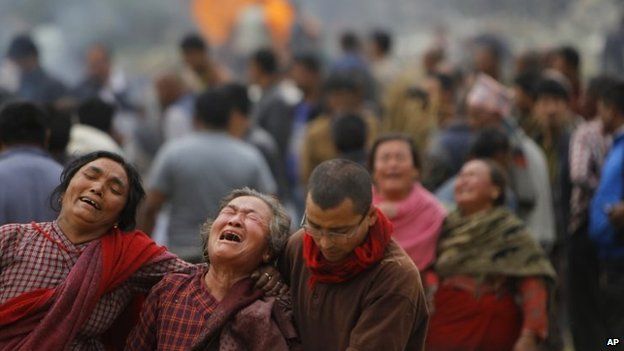
A lot of times, though, this frustration is with myself. Here I am leading a comfortable life, failing to bring any positive change in the lives of the hurting. On Saturday, I spent my day with a community that I love, worshiping Jesus and goofing off. Meanwhile, in Nepal and neighboring countries, a massive earthquake destroyed the homes and lives of thousands of people. Because I happened to be born into huge amounts of privilege, I didn't have to hear about it and remained unaware of the disaster until the following day. Even then, I felt a disconnect. If I wanted, I could pretend the earthquake was not real. Because I was unaffected by the shifting of the earth's plates, I could also be unaffected by the crumbling of human lives.
There is so much guilt that accompanies the disconnect I feel between myself and the people of Nepal. Sometimes, this guilt is so overwhelming that I want to give up hope in Christianity, in my faith. Because of this, I yearn to feel the suffering of those the earthquake has affected. And yet, I can never fully experience that pain.
This is why I thank Jesus for dying on the cross. Even though I can't suffer with those in Nepal, Jesus has suffered, and he continues to suffer as he sees his children bear their crosses. His death on the cross reminds me that my beliefs are not disconnected. They are not irrelevant to the world and the pain in the world. As the Nepalese anguish, so too did Jesus anguish. And no, that doesn't make the tragedy in Nepal okay. I am certain that those touched by the earthquake are still hopeless. But it helps to remember that, hanging on the cross, Jesus was also hopeless, crying out, "My God, my God, why have you forsaken me?"
Immanuel. God with us. God is with Nepal.
...
3600 dead. Over 6500 injured. Over 1 million displaced. Pray for Nepal.

A lot of times, though, this frustration is with myself. Here I am leading a comfortable life, failing to bring any positive change in the lives of the hurting. On Saturday, I spent my day with a community that I love, worshiping Jesus and goofing off. Meanwhile, in Nepal and neighboring countries, a massive earthquake destroyed the homes and lives of thousands of people. Because I happened to be born into huge amounts of privilege, I didn't have to hear about it and remained unaware of the disaster until the following day. Even then, I felt a disconnect. If I wanted, I could pretend the earthquake was not real. Because I was unaffected by the shifting of the earth's plates, I could also be unaffected by the crumbling of human lives.
There is so much guilt that accompanies the disconnect I feel between myself and the people of Nepal. Sometimes, this guilt is so overwhelming that I want to give up hope in Christianity, in my faith. Because of this, I yearn to feel the suffering of those the earthquake has affected. And yet, I can never fully experience that pain.
This is why I thank Jesus for dying on the cross. Even though I can't suffer with those in Nepal, Jesus has suffered, and he continues to suffer as he sees his children bear their crosses. His death on the cross reminds me that my beliefs are not disconnected. They are not irrelevant to the world and the pain in the world. As the Nepalese anguish, so too did Jesus anguish. And no, that doesn't make the tragedy in Nepal okay. I am certain that those touched by the earthquake are still hopeless. But it helps to remember that, hanging on the cross, Jesus was also hopeless, crying out, "My God, my God, why have you forsaken me?"
Immanuel. God with us. God is with Nepal.
...
3600 dead. Over 6500 injured. Over 1 million displaced. Pray for Nepal.
Thursday, April 2, 2015
Commune [/kəˈmyo͞on/]
Today is Maundy Thursday, and I just realized it about five minutes ago, so I guess that makes me a bad Christian... or maybe just a busy college student (both?). Anyway, I finished reading Nadia Bolz-Weber's Pastrix today (by the way, this book has completely changed me, and I strongly recommend it), and she concludes with this beautiful story about how her church shared turkey sandwiches and pumpkin bars with 600 people who had to work on Thanskgiving. Later, one of her parishioners talked about his own experience of feeding the crowds of Occupy Denver, saying, "Everyone is fed. It doesn't matter if you are a homeless guy who is scamming and doesn't even care about Occupy or a lawyer on a lunch break.... The only place I've ever really seen that is at communion."
Maundy Thursday commemorates the day when Jesus shared the Last Supper with his disciples, which we now remember throughout the year by taking communion/the Eucharist. But I was thinking today about the first supper--the first communion--and when I read Nadia Bolz-Weber's story, I immediately thought about the feeding of the five thousand. When Jesus' disciples give him five loaves of bread and two fish to feed this enormous crowd, Jesus breaks the bread just like he does with his disciples before he is crucified. Describing the Last Supper, Luke 22:19 says, "He took the bread, gave thanks, and broke it." Matthew 14:19 describes the feeding of the five thousand similarly: "Taking the five loaves and two fish and looking up to heaven, he gave thanks and broke the loaves." Communion is happening with a crowd of five thousand long before Jesus shares communion with his disciples and tells them what that bread symbolizes.
That's what makes communion so beautiful. It was first shared with a crowd and not just with the small group of people closest to Jesus. He breaks the bread for all the sinners in that crowd whether they truly know he is Lord or not, whether they care about his teachings or not. Just like those in the crowds of Occupy Denver, these people could be posers, skeptics, and heretics. The only commonality is that they are all sinners, and despite that--in fact, because of that--Jesus invites all of them to partake in communion. To commune with him. I really love that.
Maundy Thursday commemorates the day when Jesus shared the Last Supper with his disciples, which we now remember throughout the year by taking communion/the Eucharist. But I was thinking today about the first supper--the first communion--and when I read Nadia Bolz-Weber's story, I immediately thought about the feeding of the five thousand. When Jesus' disciples give him five loaves of bread and two fish to feed this enormous crowd, Jesus breaks the bread just like he does with his disciples before he is crucified. Describing the Last Supper, Luke 22:19 says, "He took the bread, gave thanks, and broke it." Matthew 14:19 describes the feeding of the five thousand similarly: "Taking the five loaves and two fish and looking up to heaven, he gave thanks and broke the loaves." Communion is happening with a crowd of five thousand long before Jesus shares communion with his disciples and tells them what that bread symbolizes.
That's what makes communion so beautiful. It was first shared with a crowd and not just with the small group of people closest to Jesus. He breaks the bread for all the sinners in that crowd whether they truly know he is Lord or not, whether they care about his teachings or not. Just like those in the crowds of Occupy Denver, these people could be posers, skeptics, and heretics. The only commonality is that they are all sinners, and despite that--in fact, because of that--Jesus invites all of them to partake in communion. To commune with him. I really love that.
Tuesday, March 31, 2015
The Way of Jesus
Rachel Held Evans, a woman with great spiritual authority, responded to the Indiana "Religious Freedom" law as a guest writer on CNN. Her piece is compelling and convicting, and pretty much sums up how I feel about this legislation and so many other ways some members of the Christian Church continue to perpetuate hatred. Check it out here: http://www.cnn.com/2015/03/30/living/culture-war-casualties.
For a quick overview, here are some of my favorite quotes:
For a quick overview, here are some of my favorite quotes:
"This is the tragic irony of the culture wars: The casualties tend to be the very people Jesus went out of his way to serve: the poor, the sick, the marginalized, the outcasts, the people ostracized and deemed 'sinners' by the religious elite.
And when the world sees Christians hurting rather than helping such people, in the name of political gain, our testimony is profoundly diminished.
We have lost the way of Jesus when we are more committed to self-preservation than service, more occupied with waging war than washing feet."
"Remember that the fruit of the Spirit is not power or might, influence or entitlement. The fruit of the Spirit is love, joy, peace, patience, kindness, goodness, faithfulness, gentleness, and self control, and 'against such things, there is no law' (Galatians 5:23).
And to the wounded, I offer only this: You are not alone. Please know there are field medics -- pastors and priests, artists and activists, poets and parents and healers and dreamers -- ready to welcome you back to faith and to church whenever you're ready.
We can walk the long road to healing together, even if it's with a limp."
...
My response to Indiana's law?
1) Remember that one time when Jesus said, "No, I'm not going to build a wagon for you because you're gay"? Or how about when he refused to give fish and bread to one of the five thousand because she was transgender? Nope. Me neither.
2) So this law is not only discriminatory and bigoted, but also entirely un-Christ-like.
3) Which leads me to the question: What religion are proponents of the law exerting freedom for? I adhere to the religion of Christ, continually trying (and often failing) to conform my actions to those of Jesus, who spent 30 years on earth healing, feeding, loving people, and telling his disciples to do the same (Acts of Mercy, Matthew 25:34-46). I want to be part of a Christian Church that washes the feet of those it had once oppressed.
Clearly, I've been experiencing a lot of anger about all this, and I only become more frustrated when I see another post about it on Facebook or hear about it in the news. But Evans' response put me at peace, and I'll continue to pray that things will only get better as we remember Jesus, his actions on earth, and his presence among us today.
Monday, February 23, 2015
Alone with Others
 This blog post is dedicated to Emily Dickinson, may she rest in peace.
I used to get so excited about living alone. I looked forward to the day when I could pack up everything and move to a secluded, rural area of Colorado or Montana, where no one could ever find me. That way, I could have all the introvert time I needed, and I would never have to feel drained or burned out from interacting with people. I imagined myself as a modern-day Emily Dickinson, who spent her adult life as a recluse--only I wouldn't write weird poems about snakes and death (except maybe I would because maybe that's what being a recluse does to you).
Anyway, for the longest time, I was scared I would graduate from school and would have to share my life with other people. And then, as graduation approached, my attitude complete reversed: I started getting scared that I would graduate from school and wouldn't have anyone to share my life with. This didn't really make sense to me, though. I'm an introvert. I love being alone.
So here's what I realized: there are two kinds of introverts. There are the introverts that actually like seclusion (i.e. Emily Dickinson), and there are the introverts that like to have their alone time with other people (i.e. yours truly). Really, this is all besides the point because I think community is for everyone and can work for everyone--probably even Emily Dickinson if she were still with us.
I have no idea if Jesus was an introvert or not, but we do know that he was around people all the time. Seriously, the guy was in high demand (for obvious reasons). Luke 4:31-44 tells of Jesus going from place to place, healing people as he went and getting zero downtime. People are asking him to heal their sisters and mother-in-laws and nephews and pet rabbits, and when they're not, he's got twelve grown men following him around and nagging him to play hide-and-seek. Jesus was constantly experiencing the good and bad of community.
But Luke 5:16 says, "Jesus often withdrew to lonely places and prayed." He still had those moments of introversion. This aloneness was, after all, an opportunity for prayer and community with God. This is also what the Lenten season is about--modeling our lives after Jesus, who spent forty days in the desert fasting before he even began doing all the things Luke 4 and 5 talks about. Yes, he lived in community with his disciples and those he fellowshipped with, but he remembered to be intentional about solitude--probably because he knew how important and healthy it was for him to be alone in God's presence. The same is true for anyone living in community. It's important to experience relationships with those we live or surround ourselves with, but it's okay--and entirely encouraged--to retreat.
We should remember, though, that after Jesus retreats, he returns to his community. We (even introverts) should do the same because, as I've said, our relationships with those who live like Jesus are so so so important for our spiritual, mental, and emotional health. And that's why Emily Dickinson's poetry is the way it is.
Tuesday, February 17, 2015
Lent
 Tomorrow begins the Lenten Season. I've always misunderstood Lent. In the past, I've tried (half-heartedly) to give up sweets or social media. I don't think it worked because my reasons for giving these things up were entirely selfish. I chose to give up sweets out of concern for my physical health, and I chose to give up social media out of concern for my academics. Lent isn't just another time to make New Year's Resolutions that you'll forget after the first few days. Lent is about spiritual health.
Something I've been working on this year is my tendency towards self-reliance. This past fall, I stopped making plans for my future (or at least started to stop making plans for my future). I had spent so many years worrying about what was next and trying to control the path my life was taking. Perpetual self-reliance was not healthy for me--emotionally, mentally, and spiritually. I couldn't have a closeness with Jesus because I wasn't allowing him to direct my life. So in the fall, I decided to surrender some of my plans. I didn't apply for grad schools. I didn't look for a job. And maybe that's just foolishness, but the peace I experienced about those decisions convinced me otherwise.
I am convinced community works in the same way. My self-reliance wasn't just about refusing to surrender to Jesus. My self-reliance was about my unwillingness to allow any other being take care of me or know my vulnerabilities. Because I was unwilling to be vulnerable, I was unable to form close relationships. When I started living in community, I slowly began to open up to the idea of being surrounded by a group of girls who demanded vulnerability. I remember being chastised for not calling for a ride home from work or for not letting anyone else pay for my food. But now, I feel like "Lean on Me" is sometimes our house's theme song. Our relationships are so strong because we let each other know our vulnerabilities and take care of our needs.
Think about it this way: What is more vulnerable than giving another person agency in your own life? What is more intimate than allowing another person to take care of you? Closeness with Jesus and closeness within community are so dependent on our willingness to give up our self-reliance.
Monday, February 9, 2015
gathered
Two and a half years ago, I convinced myself I didn't need relationships. I was in my first year of school, and either because I was too busy or because I was too afraid to make friends--or some combination of both--I had isolated myself. To some degree, isolation worked for me. I was good at being alone, so it didn't bother me that I had no friends at school. I could spend entire weekends without interacting with anyone, and it didn't seem to make a difference.
But slowly, two things began to happen. The relationships I did have back home became harder. When I went home for breaks, I didn't know how to be with my friends, and I would avoid spending time with them because I no longer felt comfortable not being alone. And second, my relationship with Jesus became nonexistent. Still, I convinced myself this was okay. I thrived by myself. I didn't need any of those relationships.
Except I wasn't really thriving at all. I was miserable at school, I was nearly as miserable at home, and spending time with people caused me a lot of anxiety. In Blue Like Jazz, Donald Miller describes a similar feeling:
"I know about that feeling, that feeling of walking out into the darkness. When I lived alone it was very hard for me to be around people. I would leave parties early. I would leave church before worship was over so I didn't have to stand around and talk. The presence of people would agitate me. I was so used to being able to daydream and keep myself company that other people were an intrusion. It was terribly unhealthy."
 I think when Don Miller says "unhealthy," he's talking about several different things: mental health, emotional health, and especially spiritual health. This past year, I started living in a house with ten other girls who love Jesus and want to love like he did. They've shown me love over and over and over again, and because of that, spiritually, I am much healthier. No amount of praying or Bible-reading in solitude could have done that for me.
It comes down to this. In Matthew 18:20, Jesus says, "Where two or three have gathered together in my name, I am there in their midst." We can't have Jesus in our lives without others who live like Jesus in our lives.
gathered is about community. Why we need it. How we find it. What to do when we have it. gathered is also about spiritual health, mental health, and earth health because I think those are all things that can come from living in community. Let's celebrate community together.
But slowly, two things began to happen. The relationships I did have back home became harder. When I went home for breaks, I didn't know how to be with my friends, and I would avoid spending time with them because I no longer felt comfortable not being alone. And second, my relationship with Jesus became nonexistent. Still, I convinced myself this was okay. I thrived by myself. I didn't need any of those relationships.
Except I wasn't really thriving at all. I was miserable at school, I was nearly as miserable at home, and spending time with people caused me a lot of anxiety. In Blue Like Jazz, Donald Miller describes a similar feeling:
"I know about that feeling, that feeling of walking out into the darkness. When I lived alone it was very hard for me to be around people. I would leave parties early. I would leave church before worship was over so I didn't have to stand around and talk. The presence of people would agitate me. I was so used to being able to daydream and keep myself company that other people were an intrusion. It was terribly unhealthy."
I think when Don Miller says "unhealthy," he's talking about several different things: mental health, emotional health, and especially spiritual health. This past year, I started living in a house with ten other girls who love Jesus and want to love like he did. They've shown me love over and over and over again, and because of that, spiritually, I am much healthier. No amount of praying or Bible-reading in solitude could have done that for me.It comes down to this. In Matthew 18:20, Jesus says, "Where two or three have gathered together in my name, I am there in their midst." We can't have Jesus in our lives without others who live like Jesus in our lives.
gathered is about community. Why we need it. How we find it. What to do when we have it. gathered is also about spiritual health, mental health, and earth health because I think those are all things that can come from living in community. Let's celebrate community together.
Subscribe to:
Posts (Atom)