I often feel hopeless about Christianity and what it's doing for the world right now. Not for the kingdom of heaven. Right now. I get frustrated with other Christians when there is such an obvious disconnect between their vision for the world and the reality of the world, the current, real suffering of the world.
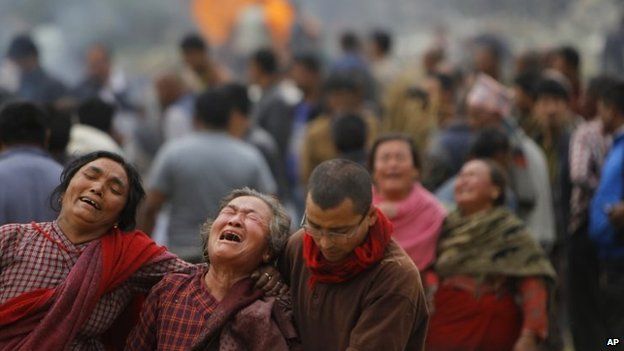
A lot of times, though, this frustration is with myself. Here I am leading a comfortable life, failing to bring any positive change in the lives of the hurting. On Saturday, I spent my day with a community that I love, worshiping Jesus and goofing off. Meanwhile, in Nepal and neighboring countries, a massive earthquake destroyed the homes and lives of thousands of people. Because I happened to be born into huge amounts of privilege, I didn't have to hear about it and remained unaware of the disaster until the following day. Even then, I felt a disconnect. If I wanted, I could pretend the earthquake was not real. Because I was unaffected by the shifting of the earth's plates, I could also be unaffected by the crumbling of human lives.
There is so much guilt that accompanies the disconnect I feel between myself and the people of Nepal. Sometimes, this guilt is so overwhelming that I want to give up hope in Christianity, in my faith. Because of this, I yearn to feel the suffering of those the earthquake has affected. And yet, I can never fully experience that pain.
This is why I thank Jesus for dying on the cross. Even though I can't suffer with those in Nepal, Jesus has suffered, and he continues to suffer as he sees his children bear their crosses. His death on the cross reminds me that my beliefs are not disconnected. They are not irrelevant to the world and the pain in the world. As the Nepalese anguish, so too did Jesus anguish. And no, that doesn't make the tragedy in Nepal okay. I am certain that those touched by the earthquake are still hopeless. But it helps to remember that, hanging on the cross, Jesus was also hopeless, crying out, "My God, my God, why have you forsaken me?"
Immanuel. God with us. God is with Nepal.
...
3600 dead. Over 6500 injured. Over 1 million displaced. Pray for Nepal.
Monday, April 27, 2015
Thursday, April 2, 2015
Commune [/kəˈmyo͞on/]
Today is Maundy Thursday, and I just realized it about five minutes ago, so I guess that makes me a bad Christian... or maybe just a busy college student (both?). Anyway, I finished reading Nadia Bolz-Weber's Pastrix today (by the way, this book has completely changed me, and I strongly recommend it), and she concludes with this beautiful story about how her church shared turkey sandwiches and pumpkin bars with 600 people who had to work on Thanskgiving. Later, one of her parishioners talked about his own experience of feeding the crowds of Occupy Denver, saying, "Everyone is fed. It doesn't matter if you are a homeless guy who is scamming and doesn't even care about Occupy or a lawyer on a lunch break.... The only place I've ever really seen that is at communion."
Maundy Thursday commemorates the day when Jesus shared the Last Supper with his disciples, which we now remember throughout the year by taking communion/the Eucharist. But I was thinking today about the first supper--the first communion--and when I read Nadia Bolz-Weber's story, I immediately thought about the feeding of the five thousand. When Jesus' disciples give him five loaves of bread and two fish to feed this enormous crowd, Jesus breaks the bread just like he does with his disciples before he is crucified. Describing the Last Supper, Luke 22:19 says, "He took the bread, gave thanks, and broke it." Matthew 14:19 describes the feeding of the five thousand similarly: "Taking the five loaves and two fish and looking up to heaven, he gave thanks and broke the loaves." Communion is happening with a crowd of five thousand long before Jesus shares communion with his disciples and tells them what that bread symbolizes.
That's what makes communion so beautiful. It was first shared with a crowd and not just with the small group of people closest to Jesus. He breaks the bread for all the sinners in that crowd whether they truly know he is Lord or not, whether they care about his teachings or not. Just like those in the crowds of Occupy Denver, these people could be posers, skeptics, and heretics. The only commonality is that they are all sinners, and despite that--in fact, because of that--Jesus invites all of them to partake in communion. To commune with him. I really love that.
Maundy Thursday commemorates the day when Jesus shared the Last Supper with his disciples, which we now remember throughout the year by taking communion/the Eucharist. But I was thinking today about the first supper--the first communion--and when I read Nadia Bolz-Weber's story, I immediately thought about the feeding of the five thousand. When Jesus' disciples give him five loaves of bread and two fish to feed this enormous crowd, Jesus breaks the bread just like he does with his disciples before he is crucified. Describing the Last Supper, Luke 22:19 says, "He took the bread, gave thanks, and broke it." Matthew 14:19 describes the feeding of the five thousand similarly: "Taking the five loaves and two fish and looking up to heaven, he gave thanks and broke the loaves." Communion is happening with a crowd of five thousand long before Jesus shares communion with his disciples and tells them what that bread symbolizes.
That's what makes communion so beautiful. It was first shared with a crowd and not just with the small group of people closest to Jesus. He breaks the bread for all the sinners in that crowd whether they truly know he is Lord or not, whether they care about his teachings or not. Just like those in the crowds of Occupy Denver, these people could be posers, skeptics, and heretics. The only commonality is that they are all sinners, and despite that--in fact, because of that--Jesus invites all of them to partake in communion. To commune with him. I really love that.
Subscribe to:
Posts (Atom)